Who are Japan’s grass eaters?

A new twist to Orientalist critiques of Japan from the West, Japanese men are still not ‘masculine’ enough. When Japanese men aren’t depicted as nerdy otaku or work-obsessed salarymen (with hidden perverted tendencies), now they’re herbivorous men. What about the idea that Japanese men perform masculinity in a variety of ways? Would that be so wrong?

Yumi's avatarDiscover Japan

Susuki (640x360) Lately my American friends have been asking me the most strange question:   “Who are Japan’s grass eaters?”  Initially I thought they were referring to vegetarians or people who ate grass, but it turned out to be something entirely different.

The media overseas has been reporting a shocking recent phenomena in Japan for some time.   According to their report, soshokukei danshi (草食系男子)  -herbivorous boy – refers to men who are not interested in dating, sex, or marriage.  These men have decided to live a life without a partner or even a romantic relationship as a way of turning their back on “macho ways.”   They find it safer both emotionally and financially to stay single and celibate.  This is a serious matter, they say, because it’s contributing to the rapidly declining birth rates in the nation.

One article cites that 60 percent of Japanese men aged between 20 and 34…

View original post 456 more words

Reblog: All Nippon Airways uses crude racial humor in TV commercial

Apparently ANA wasn’t deterred by the backlash against the Toshiba ad that featured a Japanese woman with a fake nose and a blond wig …

Enhanced by Zemanta

2013 in review

The WordPress.com stats helper monkeys prepared a 2013 annual report for this blog.

Here’s an excerpt:

Madison Square Garden can seat 20,000 people for a concert. This blog was viewed about 65,000 times in 2013. If it were a concert at Madison Square Garden, it would take about 3 sold-out performances for that many people to see it.

Click here to see the complete report.

Guest post by Elizabeth Anderson on race in American politics

Daniel Little's avatarUnderstanding Society

Elizabeth Anderson is John Dewey Distinguished Professor of Philosophy and Women’s Studies at the University of Michigan. She is the author most recently of The Imperative of Integration. This contribution extends a question posed in a recent post on the conservative war on poor people (link). Thanks for contributing, Liz!

American Conservative Politics and the Long Shadow of Slavery

Elizabeth Anderson

An “outright Marxist!”  That’s what Rafael Cruz, Senator Ted Cruz’s father, declared of President Obama on the campaign trail in April 2013.  His accusation is common on the right.  Google “Obama Marxist” and you will get about 4.95 million results.  “Obama communist” yields 40 million.  It’s a strange charge against a man who vigorously supported the bail-out of Wall Street banks as a Senator, and expanded it to other major firms as President.  Yet the charge is nothing new.  Conservatives have long accused anyone…

View original post 923 more words

Should the Japanese Government Institute an Education System for Immigrants?

by Megumi Takase

In “International Sociology” class, I was surprised to hear that in Europe, students from other backgrounds take two or three times a week to have lessons in their native languages. In Japan, some elementary schools in which there are many foreign students have Japanese classes for them to understand regular Japanese classes. However, few schools have lessons for immigrants in their own languages. In addition, there are not many ethnic schools in Japan. Even though foreigners living in Japan mostly consist of Chinese, there are only 5 Chinese Schools in Japan. If children from other countries continue to attend Japanese schools and don’t do vigorous effort to learn their history or culture, they will have difficulty in building their identities. This is one of the reasons why foreigners are unwilling to live in Japan for a long time.

In my opinion, Japan should institute an education system for immigrants. For example, it should begin classes for immigrants in their native languages. It not only benefits students from other countries but also Japanese. It will increase the number of immigrants if Japanese education system is reformed in favor of foreigners. Japanese is suffering an aging society, so Japan will face the problem of lack of labor in the near future. Thus, Japan should accept immigrants to solve these problems. In order for foreigners to be willing to come and live in Japan, Japan should create the environment for them to live comfortably. One of reforms which Japan should tackle is education system.

It will also lead to intensification of international competitiveness of Japan if many foreigners immigrate to Japan. It is said that Japanese have difficulty in speaking foreign languages. In the times of globalization, people who are fluent in many languages are needed. If immigrants grow up as bilingual and begin to work in Japanese corporations, they will largely contribute to corporations.

If Japanese government begins to institute an education system for immigrants, many people will come from other countries and live in Japan. They will serve Japanese society. It is difficult for schools to begin classes for immigrants in their native languages because immigrants come from different countries around the world. Schools should create these classes cooperating with the local universities specializing in foreign languages. It will also lead to create Japanese bilingual students.

Reference

[i] Weblio. (n.d.). Retrived October 17, 2013 from http://www.weblio.jp/ontology/%E4%B8%AD%E8%8F%AF%E5%AD%A6%E6%A0%A1_1

A few thoughts on abstracts for NIH grants

Part of the publish or perish circle of life in academia is getting money for our research, without which we can’t do the work, and thus can’t publish, and hence risk perishing … which we all will do anyway. Here are some helpful tips to keep in mind, as we try to cram as much as possible into a few paragraphs in our grant applications.

Potnia Theron's avatarMistress of the Animals

Abstracts, which are now called project summaries, are critical to your grant. Sometimes, that is all that someone who gets to score you will ever read (ie the other people on study section who are not your reviewers). Writing the abstract after the rest is done allows you to take the best sentences from elsewhere in your grant combine them, smooth them, adjust them. This should not be too hard to write, after you have written your kick ass grant proposal. That doesn’t mean you shouldn’t take the time to make sure its good.

As an aside – if you get funded, the abstract is what is publicly available to anyone with a computer and an internet connection. If you are applying for jobs, ten to one someone on the search committee will check you out in RePORTER. If you are doing anything within the academic community, someone will…

View original post 775 more words

More Accounts Emerge of Japan’s Use of Sex Slaves During WWII

Japan’s national archive recently released documents that detail Japanese troops’ role in the sexual slavery of foreign women during World War II. No word from Osaka Mayor Hashimoto or others who have denied that such events occurred.

Travel Shows Mirror Japan’s Imagined Globalization

JAPANsociology got its first mainstream media citation, in a column by Philip Brasor in the Japan Times, “Travel Shows Warp True Globalization.”

Brasor notes the parochial nature of Japanese travel shows, which often depict the world outside Japan as worthy of fear and caution. To paraphrase Jennifer Robertson, such events are about presenting the world in a way that reduces the ontological anxiety  Japanese may experience when worrying about Japan’s place in the world.

The 2020 Olympics in Tokyo follow the 2005 World Expo in Aichi, and the 2002 World Cup in Japan and South Korea. Each event was to usher in a new era of internationalization, strengthening Japan’s connection to the rest of the world. Instead, we see the more things change, the more they stay the same. The question isn’t whether Japan is connected to the rest of the world, but how the Japanese people interpret that connection.

As WI Thomas and DS Thomas wrote in 1928, “If men define situations as real, they are real in their consequences.”

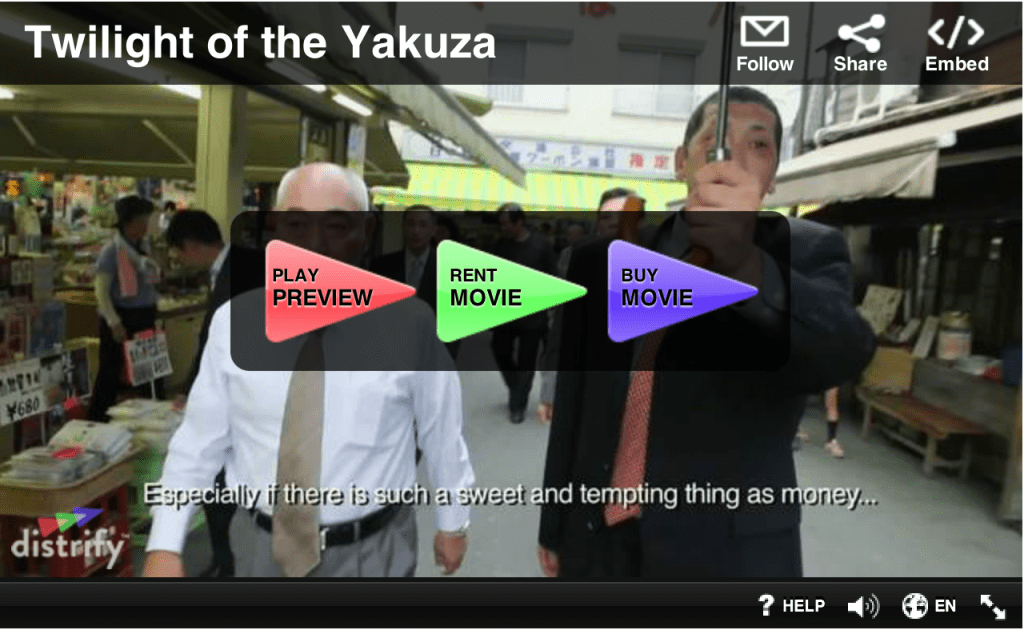
Twilight of the Yakuza

Click on the image to view Twilight of the Yakuza on distrify.com

Click on the image to view Twilight of the Yakuza on distrify.com

by Robert Moorehead

Sebastien Stein’s film, Twilight of the Yakuza, explores the decline of Japan’s organized crime syndicates. Stein says the yakuza are a dying breed. Their members are aging and the government of Japan has launched a large-scale crackdown on them to eradicate them once and for all. But who are the yakuza? A threat to public safety or a necessary evil?

(For a detailed review of Stein’s film, check out foreignpolicyblogs.com, and for a great read on the yakuza post-March 11, check out Jake Adelstein’s article on japansubculture.com. The rest of this post borrows heavily from Stein’s description of his film.)

The film follows three members of the yakuza: Yoichi Nakamura, the “Tiger of Ginza” who was recently excommunicated from the Sumiyoshi-kai; Toyohiko Tanaka, head of the Matsuba-kai; and Daikaku Chōdōin, a yakuza consultant. Nakamura’s story is the most compelling, as he struggles at age 60 to leave his yakuza past behind him and succeed as a “legitimate” businessman.

Tanaka laments the low standards and lack of honor of young yakuza. As Jake Adelstein has described them, “the yakuza are Goldman Sachs with guns increasingly white collar criminals who follow no code and who serve no function in society.” Deeply rooted in Japanese society, the yakuza are seen as a necessary evil and ‘problem solvers.’ They have been around since the 1700s and were said to protect the weak from the strong, following a rigorous code of honor. Several clans even contributed aid for the victims of the recent earthquake and tsunami. As Adelstein notes:

in the midst of the dark days that followed the great earthquake, there was a time when the yakuza lived up to their claims to be humanitarian groups, and it was oddly inspiring. For a brief time, the yakuza, the people and the police all had a common enemy: natural disaster. And as the saying goes, ‘the enemy of my enemy is my friend’ and for that short time — it seemed like we were all friends.

Unlike the mafia, the yakuza is a legal, public group making them relatively easy to check on. You can find their offices by looking on the National Police Agency website, and you can read all about them in their many fanzines. I’ve even sat near them at Japanese pro baseball games in Nagoya, while they tried to explain the sport to the Filipino women sitting with them. Strict government crackdowns have moved many yakuza underground. As the police concentrate their resources on the yakuza, many criminals simply don’t register with clans anymore and start operating underground, evading the grasp of police. A clear trend is emerging towards a new structure of organized crime in Japan, resulting in a steep decrease in the numbers of the traditional yakuza while the underground is soaring – including foreign Russian and Chinese mafias.

This documentary deals with the struggle of the yakuza for its survival and the restructuring of the organized crime scene in Japan. Furthermore, unprecedented access to the secret world of the yakuza gives you an insight on who the yakuza are: criminals, outcasts, but also family men and a part of Japanese society.

Japan Grapples with the Rise of Hate Groups

This YouTube video from “The Real News.com” provides an interesting and informative look at the recent protests against resident Koreans and other minority groups in Japan.