Jeffrey and Ivan have just released another powerful video on Fukushima—this time from inside the evacuated zone with some farmers who have refused to leave. It’s a powerful, moving look at the damage inflicted by the nuclear disaster, and the lives affected by it.
The documentary “Women of Fukushima” is available for free online viewing this week.
by Robert Moorehead
To highlight the ongoing difficulties experienced by many in Japan, the wonderful and inspiring documentary ‘Women of Fukushima’ is available for free online viewing this week. To see the documentary, click on the image above and you’ll be taken to vimeo.com.
As one: People join hands Sunday morning on a beach in Iwaki, Fukushima Prefecture, ahead of the second anniversary of the Great East Japan Earthquake. | KYODO
by Robert Moorehead
Two years ago today, at 2:46pm, Japan suffered one of the worst disasters in its history. A magnitude 9 earthquake shook for 6 minutes, followed by a massive tsunami that destroyed entire cities and carried people and debris out to sea. The quake and tsunami also crippled the Fukushima Dai-Ichi nuclear power plant, taking out its backup power generators and safety systems. Tens of thousands remain displaced and likely never to return to their homes.
I watched news coverage of the tsunami and nuclear disaster from the safety of the United States, while my suitcases sat packed and ready for travel to Japan to start my position at Ritsumeikan. I heard American broadcasts warn of everything but Godzilla marching down the street, and Japanese broadcasts calmly, quietly, try to balance informing the public with protecting those in power. Somewhere in between those two extremes lied the news people needed to hear, and that is still largely ignored in the mainstream Japanese press.
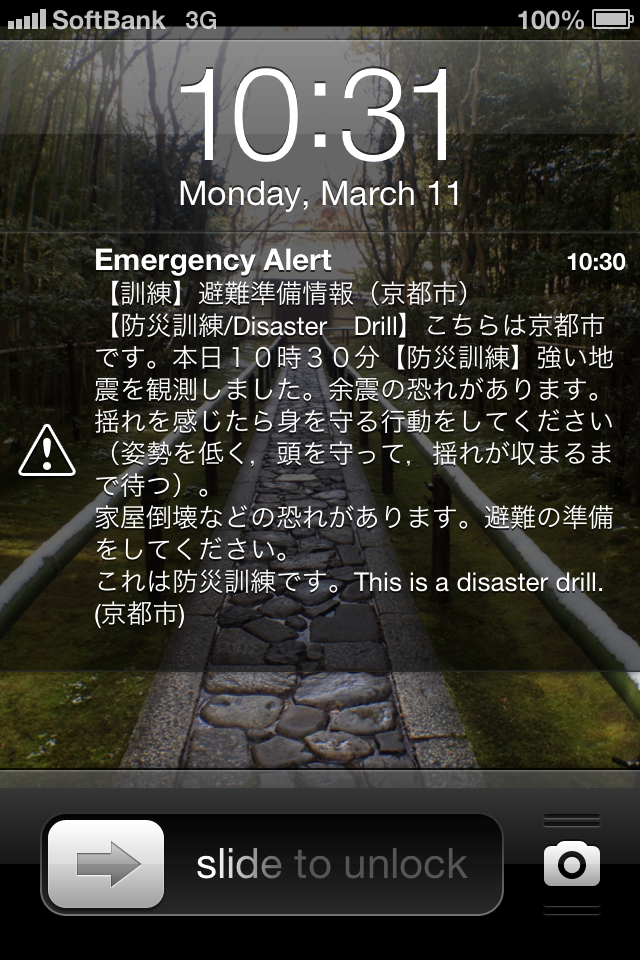
Governments across Japan conducted disaster drills on the anniversary of 3-11.
This week, TV news have covered elements of the nuclear disaster in detail, and undoubtedly many people across the country will observe a moment of silence at the time the quake struck. But for the those who had to evacuate, there is likely no going back. Many still live in poorly built temporary housing and struggle to form new community ties. Victims of the disaster continue to struggle with domestic violence, unemployment, depression, and suicide. And many live just outside the evacuation areas, near radioactive hotspots, and in areas where radiation cleanup work has been shoddy and ineffective. The yakuza, Japan’s labor broker of last resort, have done well in the aftermath of the disaster, but how about the people of Tohoku?
While disasters often bring people together, leading us to help each other and to sacrifice for the common good, eventually the institutionalized patterns of corruption and inequality reappear. Prior to the disasters, the regulatory bodies that ostensibly existed to protect the public from the deadly hazards of nuclear power, instead served to protect the profits of the agencies they were supposed to regulate. This brazen failure of governance raises the question I have asked my Japanese students each semester, whom does the government serve? Does it represent you, your voice, your interests, or those of Japan’s corporate oligarchy? Is the system rigged in their favor? The questions are largely rhetorical, but I often get the sense that students had not previously given this issue much thought.
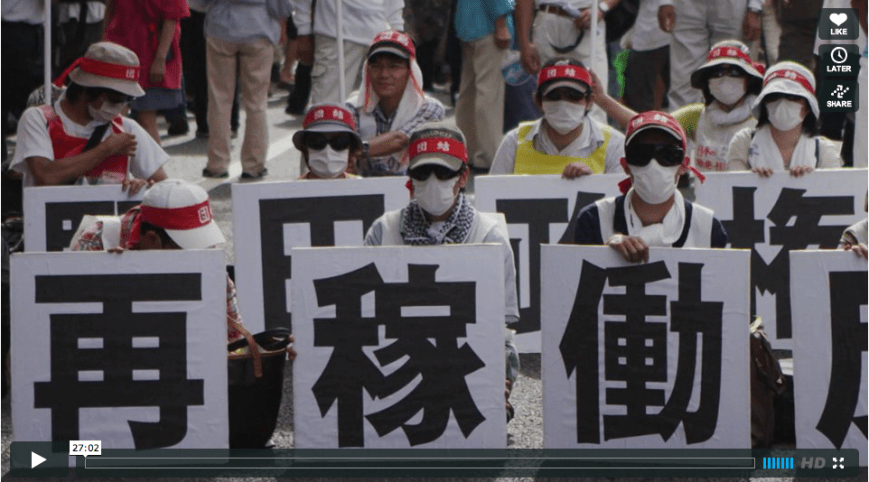
Nobel laureate writer Kenzaburo Oe (right), joins a demonstration after an anti-nuclear rally in Tokyo on Saturday, March 9, 2013. Thousands of anti-nuclear demonstrators rallied in Tokyo, urging Japan’s government to abandon nuclear power. — PHOTO: AFP
One cliche often heard in Japan was that 3-11, much like 9-11, changed everything. The challenge Japan faces is whether the events changed anything at all. Beyond the buildings and nearly 20,000 lives that were lost, what has changed?
The Abe administration moves ahead with plans to restart Japan’s nuclear power plants, and a newly restructured nuclear regulatory agency struggles for legitimacy. Will the new agency actually regulate the industry? Will the agency shut down nuclear power plants that were built on active earthquake faults? Will it enforce new safety regulations? Will the government be able to turn down the companies that have invested billions in plants and fuel processing facilities? Who will the government represent in making those decisions?
A protester holds an anti-nuclear power sign at a rally in Tokyo on Saturday, March 9, 2013. Thousands of anti-nuclear demonstrators rallied in Tokyo on Saturday, urging Japan’s government to abandon nuclear power. — PHOTO: AP
My students tell me that Japanese people don’t protest and that there are no social movements in Japan. And if you only read the mainstream press, this perspective makes sense. But tens of thousands of people across Japan continue to protest the return to nuclear power. Will these voices be represented in government? (It’s also disheartening to hear my students ignore 60 years of protest in Okinawa, but that’s the subject for another post.)
It will take another 40 years to decommission the Fukushima Dai-Ichi plant, requiring the use of technologies not yet invented to remove melted nuclear fuel from inside the damaged reactors and spent fuel pools. Righting the country’s course will require continued vigilance. If that happens, then 3-11 will really have changed everything.
Let’s turn the lens from racial stereotypes Japan to those in the United States, to appreciate Douglas Kim’s music video “I’m Asian American.” Parodying Ben Fold’s “Rockin the Suburbs,” Kim takes on the stereotypes that all Asians look alike and don’t speak up, that they’re all on track to becoming doctors, pressured by Amy Chua’s Tiger Mothers, and ignored by Asian American women.
As Kim writes in the YouTube description of his video, “Our friendly neighborhood American Asian is just a regular guy trying to get through life in America without getting hated on by Asians and Americans, is that too much to ask?”
I’m thinking of showing this video in my upcoming class on Race and Mass Media, between the Slanted Screen and Better Luck Tomorrow. For my Japanese students, these American stereotypes of Asians are completely foreign. My students often struggle to imagine the experience of being in the minority and subject to such stereotypes. When I’ve shown clips of yellow-face characters like Mr. Yunioshi from Breakfast at Tiffany’s or Long Duk Dong from Sixteen Candles, I expected students to get angry. Instead, they dismiss the images as simply inaccurate. Some even say they understood that others might stereotype the Japanese and other Asians, just like the Japanese and other Asians stereotype other people.
At first, I was struck by how seemingly blasé they were to the images, but gradually we realized that these images were but one of many images of Asian people that those living in Asia see everyday. They see Asian actors playing every role, from doctors and lawyers, to janitors, mechanics, and office workers. From this perspective, seeing one ridiculous caricature might not seem like such a big deal.
In the US, on the other hand, Asian characters in film and on television have been much fewer and farther between. So those few portrayals carry much greater weight—just there are few non-Japanese on television and in film in Japan, and many foreigners seethe when they see a gaijin playing the fool. Tarento (performers) such as Bobby Ologun and Rola make viewers laugh with their misspoken Japanese and silly expressions, and the ability to entertain others is a great thing—but not at the exclusion from other performing other types of roles.
Kim’s video highlights the stereotypes of Asian Americans, and then smashes them, like the cello he destroys at the end of the video. And just as his Tiger Mom shifts to rocking out with him, hopefully Kim’s viewers will come to see past the stereotypes.
Here are the lyrics:
Let me tell y’all what it’s like
Being Asian we all look alike
It’s a bitch if you don’t believe
Read about it in a magazine
Sham on
I’ve got Tiger momma on my brain
So intense that I can’t explain
All alone in my Asian pain
You know they’ll punish me if I complain
I’m Asian American
And my friends are all pre-med
I’m Asian American
Get a B and I’ll be dead
I’m Asian American
I take the grades and face the facts
Some advisor with computers puts me on some shitty track
I’m pissed off but I’m too polite
When Asian girls all want a guy who’s white
Mom and dad you made me so uptight
Can’t ever party on a Friday night
Don’t know how much I can take
Give me something I’m allowed to break
I’m Asian American
Doing what my parents said
I’m Asian American
And it made me talented
I’m Asian American
I write on facebook and face the facts
Typing wall posts on computers is the only way I mack
In a haze these days
I’m cursing my poor eyesight
And I can feel something’s not right
I can feel someone’s trapped me in a lame cliche
Sending dirty vibes my way
Cause I would not be their robot
And I would not be a white collar slave
It wasn’t my idea
Never was my idea
Just drove to the store for some ramen and jap chae
Y’all don’t know what it’s like
Being Asian we all look alike
It gets me real pissed off and makes me wanna say
“Oh hello! Being Asian American has had profound unique effects on one’s psychological disposition, and as such, they’re not always able to effectively communicate their feelings in a way that doesn’t seem contrived, irrationally angry, oh thank you, or insecure. Wait, what’s that…”
Stuck in someone else’s song
I’m Asian American
Where the pho do I belong
I play some ball and face the facts
Can’t just sit behind computers
Gotta take it to the rack these days
After protests by local non-Japanese residents, the Genky store in Minokamo, Gifu prefecture, has taken down the signs that warned foreign customers that they were being watched as potential criminals.
My Portuguese skills are limited, so hopefully a reader can help translate the video. I am encouraged by the response of the local non-Japanese community in standing up for their rights, and by the fact that the store management responded to those concerns.
Stereotypes are harder to maintain when the person the stereotypes supposedly describe is standing right in front of you. In that case, we sometimes fall victim to what Tim Wise has called “enlightened exceptionalism.” That is, have prejudiced views about a group but making an exception for individual members of that group. This approach lets prejudiced whites vote for Barack Obama, while still holding racist views of African Americans. In this case, clerks at the Genky store might have said to the protestors, “Of course the sign doesn’t describe you. It refers to other foreigners.”
The protestors used the uncomfortable tension the staff likely felt when confronted with protests to their advantage, in demanding that the signs be taken down and in rewarding the removal of the signs with applause. In so doing, they hopefully have taken a step toward turning a foe into an ally. But whether the staff at Genky will still watch non-Japanese customers with suspicion or not, at least that suspicion is no longer publicly posted for all the world to see. The public posting of the signs reproduced and reinforced negative stereotypes of foreigners in Japan.
Here is an update to my recent post on the American teacher who is being challenged for his lessons on racism and discrimination in Japan. Medama-sensei has posted an update, explaining why he will not be taking down his videos. Ganbare, sensei! And thank you for speaking truth to power.
After the posting of signs alerting foreign shoppers that they’re being watched for crimes at Genky markets, the Cabinet Office has announced the results of a poll on Japanese attitudes towards foreign residents of Japanese descent (Nikkei Teijū Gaikokujin). (Here’s a link to English coverage in the Japan Times.) 1,883 Japanese people responded to the survey, out of 3,000 asked, completing short structured interviews. The results of the survey are encouraging, with 80.9 percent of respondents stating that they would accept Nikkei into their communities. However I wonder about social desirability effects, or the extent to which people are saying what they think will make them look good. Is this a case of tatemae over honne?
The survey asked respondents if they knew that there were Nikkei living in Japan, and how they knew this. Nearly 53 percent the respondents either knew that Nikkei were living in Japan, or had heard about it. 46 percent answered that they did not know that this group was living in Japan. The fact that Nikkei are concentrated in industrial regions of the country may account for the high percentage of Japanese who were unaware that this group is here. (At its peak in 2007, nearly 400,000 South Americans were registered residents in Japan. Much of this population is either of Japanese descent, or is a family member of someone of Japanese descent.)
Only 16.7 of respondents who knew of the existence of Nikkei in Japan (that is, about 9 percent of all respondents) knew or had worked with someone who was Nikkei. Nearly 73 percent had heard about this group on TV, and 48 percent had read about them in the newspaper. Having less than one out of 10 respondents actually know someone who is Nikkei means that the Nikkei remain vulnerable to negative depictions in mass media. The National Police Agency fuels this situation by continuing its inaccurate connection of foreigners with crime. Fear sells newspapers and funds budgets.
88 percent of respondents state the Nikkei need to learn the language, and nearly 92 percent state they need to learn Japanese culture and customs. More specifically, when asked how much of the Japanese language and culture Nikkei should know prior to coming to Japan, 46 percent responded that the Nikkei should know enough to be able to live independently (fujiyū shinai). Another 42 percent responded that they should know the bare minimum to get by in their daily living. 41 percent answered that the Nikkei should be familiar with Japanese culture and customs before coming, while another 50 percent think they should at least learn this after they arrive. These points seem fairly obvious. Economic security and social mobility in Japan require learning the Japanese language and culture, and the Nikkei are adapting. Assimilation happens every day, in many little ways, even by those who might be opposed to “turning Japanese.”
The survey then examines respondents’ support for government policies to facilitate this assimilation, including programs for Nikkei kids in school, interpreters at Hello Work employment centers, and skills training for Nikkei workers. The survey did not include any discussion of how much money respondents would want the government to spend on these programs. 87 percent of respondents stated that special policies to facilitate the integration of the Nikkei should be either maintained (nearly 60 percent) or increased (27 percent).
The most surprising result was that nearly 81 percent said that they were open to accepting Nikkei into their local communities. 30 percent said they would accept them, and nearly 51 percent replied that they were somewhat open to accepting them (“Dochirakatoieba, ukeiretai“). Nearly 13 percent said they would prefer not to accept Nikkei into their local communities.
So what does this mean? What does it mean to ‘accept’ Nikkei into your community? Can they rent an apartment in your building? Work in your company as something other than a manual laborer? Can they join your social groups? Can they marry your daughter? And what are the conditions of this acceptance? Are they welcome as long as they act Japanese?
On the one hand, I’m encouraged by the support for Nikkei in Japan. It’s certainly better than if they had said the opposite. But … I’m skeptical. South Americans in Japan, Nikkei and non-Nikkei alike, have told me very clearly that they do not feel included in Japanese society. Instead, borrowing some phrases from Eli Anderson’s The Cosmopolitan Canopy, they’re perpetually ‘on probation.’ In this provisional status, any misstep can be used against you as a sign of the fact that you’ll never fit in. You can enjoy a certain bonhomie with Japanese, but there’s always that chance that you’ll make a mistake with the language or do something else wrong—and those faux pas could out you as a perpetual gaijin (foreigner/outsider). There’s always the risk of the gaijin moment, in which a Japanese person calls you out on your foreign status by calling you gaijin (or the gaijin‘s dressed up cousin, gaijin-san) or posting signs in stores warning all customers that gaijin are being watched as potential criminals.
Scholars have noted that surveys are better at reflecting respondents’ public performance of attitudes about minority groups, than at accurately measuring people’s “real” views. We’ve become really good at hiding what we think, and instead we present a front stage image of ourselves that tries to make us look good. Survey techniques that pursue the issue with flexible follow-up questions reveal more negative views, as do in-depth interviews. In Japanese, these presentations of self are defined as tatemae (your front stage performance) and honne (your true beliefs). So to what extent do these questions reflect respondents’ real views? Ethnographic research on this topic reveals persistent barriers to the fuller integration of non-Japanese into Japanese society. People will often say they’re open to having other groups live in Japan, but when push comes to shove, foreigners remain on probation.
Hopefully government officials will use this survey to promote further initiatives to empower the Nikkei (and hopefully other non-Japanese) in Japan. Publicly conducting the survey, posting it on the Cabinet Office website, and releasing it to the press, may indicate that the government is testing public support for such initiatives.
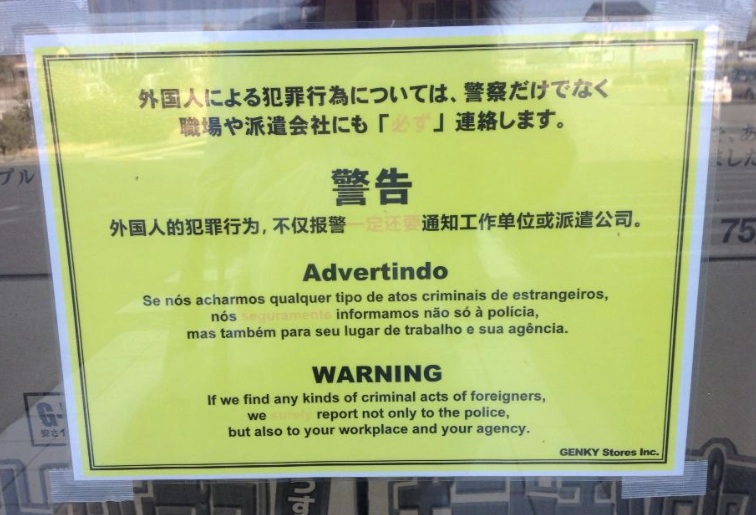
“WARNING If we find any kinds of criminal acts of foreigners, we SURELY report not only to the police but also to your workplace and your agency.” – GENKY Stores Inc (a drugstore in Kani-shi, Gifu-ken, dated February 28, 2013, taken by HSD, courtesy of shared links on Facebook through SM)
by Robert Moorehead
Arudō Debito posted the above picture on his blog, debito.org, as another example of the persistent stereotype that connects foreigners with crime. As other posts on my blog have shown, this stereotype is not unique to Japan and is inaccurate. Simply put, foreigners are no more likely to commit crime than the native-born are. Debito’s blog points out that instances of shoplifting are increasing in one demographic group: elderly Japanese are committing shoplifting in increasing numbers. However, their crimes are often depicted in much nicer ways, as crimes of loneliness.
As a foreign resident of Japan, shouldn’t I also be on the lookout for crime? And shouldn’t I be looking out for all crime, and not just the tiny percentage committed by the country’s tiny foreign population? If non-Japanese are less than two percent of the population, shouldn’t we really be focusing on the other 98 percent? Something tells me they’re committing way more crime. Drawing on the Occupy Movement, maybe foreigners’ rallying cry should be “We are the 98 percent.”
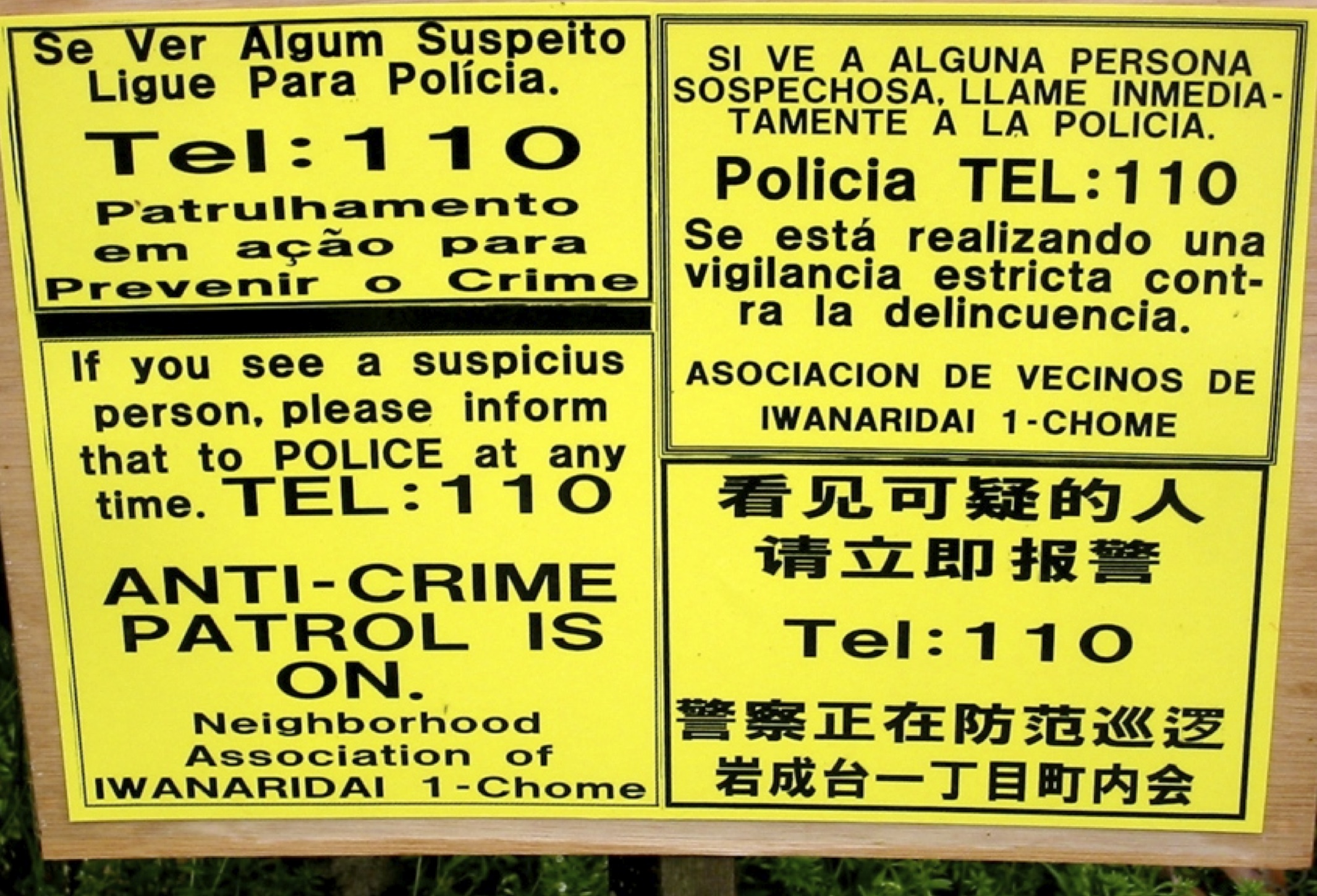
When I lived in the city of Kasugai, in Aichi prefecture, most homes in my quiet suburban neighborhood were decorated with crime-watch signs in Chinese. The fact that there was no crime wave, Chinese or otherwise, was irrelevant, as was the fact that this supposed threat made up only 0.5 percent of the city population. Rumor had it that years earlier, someone had their home had broken into, and the alleged perpetrator was Chinese.
Following the logic that if one is guilty, all must be guilty, many homes in Kozoji New Town were festooned with signs in Chinese from their neighborhood associations, warning that residents would report anyone who looked suspicious (and Chinese) to the police. While an occasional sign was in Japanese, most were not. The enterprising neighborhood association of Iwanaridai cast a broad net over most foreigners in the area, putting up crime multilingual watch signs in Portuguese, Spanish, Chinese, and English.
Beyond perpetuating stereotypes that foreigners are somehow more likely to commit crime, these signs equate not being Japanese with crime and being Japanese with being law-abiding. They warn Japanese to be on the lookout for foreigners, and they warn foreigners that they’re being watched. They’re also an affront to our (shared?) humanity.
Update: The issue has prompted a video response on YouTube:
In the same spirit as my last post in which I pleaded for sales of my book (well, the book in which I wrote a chapter), this post gets at the challenge of accurately measuring the impacts of our academic work. Inevitably, some statistical measure of our work gets created, reducing our professional lives to a series of numbers. But how accurate are those numbers? What do they measure? How can they reflect the quickly changing ways in which we’re sharing ideas? If we’re going to be reduced to numbers, how can we make sure that those numbers help us, rather than hinder us?
I read. A lot. Still I’m constantly amazed at how little of the massive amounts of information available to me I’m actually able to absorb. It is no surprise that this is an affliction shared by the research community. Scientific research is available for public consumption in ways that would have seemed unimaginable just a few short years ago and the sheer volume can be overwhelming.
“In growing numbers, scholars are integrating social media tools like blogs, Twitter, and Mendeley into their professional communications. The online, public nature of these tools exposes and reifies scholarly processes once hidden and ephemeral. Metrics based on this activities could inform broader, faster measures of impact, complementing traditional citation metrics.”
These alternative metrics, or altmetrics as they are commonly referred to, are increasingly gaining credence as a way to track the sphere of influence of social media in the scientific community. It…
Last year, I published a chapter in the book Language and Citizenship in Japan. The fine folks at Routledge released the book in hardcover and Kindle formats, and now we’d like to see the book in paperback. Why? Because the hardcover book costs $116, and the Kindle edition $100. Only libraries will purchase the book at that price, and I’d like to see the book on more people’s shelves. We do this work not for book royalties, but to spread and share ideas.
Routledge generally sells paperbacks at a fraction of the the cost of hardcovers, and a paperback edition would likely bring the price of the Kindle edition down, also. The lower the price, the more likely people will buy the book and order it for classes—and the more our ideas will be part of the debates.
To get the magic paperback edition released, Routledge first needs to sell 200 copies of the hardcover. We can get there if more libraries purchase the book. So, if your library doesn’t already have it, then please encourage them to order it. This link gives you the information your library will need to order the book from Routledge: http://www.routledge.com/books/details/9780415897228/
Here’s a blurb about the book:
The relationship between language and citizenship in Japan has traditionally been regarded as a fixed tripartite: ‘Japanese citizenship’ means ‘Japanese ethnicity,’ which in turn means ‘Japanese as one’s first language.’ Historically, most non-Japanese who have chosen to take out citizenship have been members of the ‘oldcomer’ Chinese and Korean communities, born and raised in Japan. But this is changing: the last three decades have seen an influx of ‘newcomer’ economic migrants from a wide range of countries, many of whom choose to stay. The likelihood that they will apply for citizenship, to access the benefits it confers, means that citizenship and ethnicity can no longer be assumed to be synonyms in Japan.
This is an important change for national discourse on cohesive communities. This book’s chapters discuss discourses, educational practices, and local linguistic practices which call into question the accepted view of the language-citizenship nexus in lived contexts of both existing Japanese citizens and potential future citizens. Through an examination of key themes relating both to newcomers and to an older group of citizens whose language practices have been shaped by historical forces, these essays highlight the fluid relationship of language and citizenship in the Japanese context.
It’s an excellent book, with engaging chapters written by leading scholars that are appropriate for general and academic audiences. If I weren’t already in the book, I’d definitely buy it—in paperback. And if my library didn’t have it, I’d push them to order it.
I’ll avoid for now any existential whinging about the fact that we can’t even sell 200 copies of a fine book. It’s depressing, and I’d rather not think about it. But this is a reflection of the tight market for academic books, where good books don’t get ordered because of shrinking budgets. Less expensive editions of books don’t get published because the more expensive editions didn’t sell, thereby discouraging people even more. It’s a downward spiral. But we can try to stop this downward trend by promoting each others’ books, and by gently nudging our librarians toward the texts that we want to read.





 JAPANsociology