Amid debates over the cost of higher education and the struggle to keep the door open to under-represented groups, this post reminds of the need to make failure an easier, less expensive option. In Japan, the costs of failure are high. Students are prepared to march down a narrow path of getting into the right high school and then the right university, followed by getting a job at a major corporation. Veer off that path and you might find yourself shut out completely. Such a system goes beyond discouraging risk-taking to making taking risks nearly fatal. Tressie McMillan Cottom writes “One of the rarely discussed consequences of the high cost of college for some students is that debt can effectively calcify a system whose flexibility is a strength.” Such calcification seem to have hit Japanese institutions decades ago, such that students get rewarded for feeding the process. What does this portend for those of non-Japanese or mixed ancestry? When students and job candidates are measured for their Japanese calcium content and not their unique contributions, how much harder is it for them to gain a foothold in Japanese society?
I came out of the closet on twitter today with an idea I’ve had for some time. Part of being a junior scholar is learning what ideological wars you don’t have the gravitas to wade into. The hyper-focus on degree completion and persistence is one of those. But since the cat is out of the proverbial bag, I will own this one.
Degree completion is a good thing. I will say this and many will still ignore it but I’m just covering my bases here.
Degree completion is a good thing. Persistence is a good thing. Sticktoitiveness is a good thing.
But the real thing is that, for some students, being able to move in and out of college over time is a net positive and a defining benefit of our structure of higher education.
The many entry points of our higher education system is fairly unique among education systems…
What do Japanese people think about hafu? In the video about hafu in class, the Japanese interviewed responded to this question that hafu are pretty and cool, have good command of some languages, and behave socially, and some of the interviewees envied hafu and even wanted to be hafu for their image. Japanese people tend to have positive image about hafu in this way, but it seems that they do not really understand hafu because, in spite of such images, there are some problems with which hafu encounter in Japanese society.
The first problem is that hafu are often treated as if they were foreigners when they look like Westerner. For example, when they are hunting for a job, they are asked if they speak English very well or they go to attend church on Sundays. This is because Japanese people have the wrong view that Westerners, or Western-looking people, are English speakers and Catholics (Haefelin, 2013). However, hafu were raised in Japanese society and are familiar with Japanese culture, and some hafu are not so good at commanding English. Furthermore, the second problem is that hafu are often discriminated against especially in rural areas, no matter that they look like Western or Asian. I found a person who has a Japanese parent and a Chinese one on the Web and he once has had negative feelings for Japan due to discrimination which he experienced; yet he was sure that he would not be accepted in China as well because he had no command of Chinese language and was hardly close to Chinese culture (Yamashita, 2013). I think that hafu share Japanese culture, customs, and language with Japanese people who have Japanese parents, so they are not foreigners but Japanese.
In order for hafu to join in Japanese society, I believe that the Japanese should change their view on them, and there are some means for the conversion of the view. One of them is to teach children other cultures at elementary schools. While adults belong for a long time to Japanese society which avoids hafu, children have flexible thoughts. Consequently, it is thought that education of multiculturalism at an early age is efficient for forming a society which better includes hafu. Such a society cannot be achieved soon, but now that one in thirty babies in Japan is hafu, I think that they will come to be accepted in society gradually.
Some Japanese people regard hafu as special, and admire them, but it is true that they have difficulty belonging to Japanese society. For a society open to them, I think that to appeal to flexible mind of the young is of great significance. In the stream of globalization, I believe that this will be realized although it requires a long time.
References
Haefelin, S. (2013, February 18). Haahu to shushokukatsudou [Hafu and job hunting]. Haahu wo kangaeyou [Let’s think about hafu]. Retrieved May 7, 2013, from http://half-sandra.com/column/2013/02/18/1423.php
Yamashita, M. (2013, April 11). 30 nin ni 1 ri ga haahu no jidai tachihadakaru bunka no kabe wo dou norikoeruno ka? [The era that 1 in 30 is hafu – how do they overcome the cultural barrier in front of them?]. WEDGE Infinity. Retrieved May 7, 2013, from http://wedge.ismedia.jp/articles/-/2702
Through globalization, a lot of companies have an office and a factory in foreign country, and people have many opportunities to work overseas. However, Japanese government allows people to have citizenship of only one country. As a result, Japanese people who work in a foreign country cannot get a service as citizen of the country without resigning their Japanese citizenship. However, getting other citizenship makes people difficult to come back and live in Japan. In some countries, government allows people to have dual citizenship, and it helps people to work in other country, but I think that dual citizenship has also some disadvantages.
Dual citizenship has both advantage and disadvantage. Firstly, getting dual citizenship makes people feel more comfortable to work in foreign country. For example, people have no right to vote for the person who governs the country where they live if they have only Japanese citizenship. Moreover, people cannot get service without citizenship there such as a support of a fee for medical care and education. Therefore, dual citizenship gives people a support to live in the country. However, it also has demerits. Dual citizenship makes the tax system much more confused. Which government do people have to pay tax to? Which government do people get pension from? Now, tax and pension are already very complex problem which the government has. By introducing dual citizenship, the government must manage people who work all over the world.
Then, I suggest that people have two types of citizenship, main citizenship and sub citizenship. This system has the advantage of dual citizenship and solves the disadvantage which it has. First, this system gives people services such as medical care support and education in the country where they work like dual citizenship. Moreover, this system solves the problem of tax and pension. By dividing two citizenships into main and sub, it is easy to divide tax into the tax for home country and the tax for the country where people work. Moreover, this system makes people more flexible to change the second citizenship because they have the main citizenship.
In conclusion, following the globalization, the opportunity to work overseas is increasing. The current system of citizenship cannot support people to work in foreign country. I think that Japan should suit the change of the society by introducing dual citizenship. However, dual citizenship has still disadvantages. Then, allowing two types of citizenship, main and sub, makes up for the weakness of dual citizenship.
Recently, in Japan there are a lot of “hafu” who is one parent is a foreigner who is white people. Their faces are different from so-called “Japanese” and they are often thought as a foreigner in Japan, because consciousness of Japanese people is “Japanese is Japanese”. This means that people think Japanese has a similar face as Asian ethnicity, so they are thought as a foreigner. Another reason why people think they are foreigner is also that Japan is said to be a mono-racial country. Hafu is rare to ordinary Japanese. These facts result in that situation in Japan.
Hafu has a Japanese citizenship, and they have lived in Japan since they were born. Some of the hafu has an identity as a Japanese citizen. However Japanese people have a consciousness as mono-racial country. This is a serious problem to hafu. In order for them to be accustomed to Japanese society comfortably, Japanese government should create a class about multiculturalism or different culture from the elementary school. By taking a class in the early period of children, they can understand or learn hafu or another culture and foreigner. International school is a good example. In our class, we watched a movie about discrimination and the identity of hafu. In the movie, one hafu said that his company forced him to use his French name because he could be forgiven by customer when he mistook. This is a terrible discrimination. I think that the boss of him who forced him to use the name hasn’t touched another culture or foreigner in his childhood and he doesn’t understand the feeling of them. If he understood the feelings, he would not say such a terrible thing. In Japan, a lot of people don’t have an opportunity to contact with foreigners who have different culture and racial background. This contributes to that discrimination indirectly, so it is important for children to take the class.
I think that it is difficult for us to change this situation because Japan is said to be a mono-racial country and people don’t have a consideration as to foreigner or hafu even today when globalization has progressed. Besides, Japan doesn’t have a lot of immigrants and the policy toward foreigner is also hard or rigid. I don’t intend to say that Japan should take an action drastically to multiculturalism because the measures about it are not prepared for. However Japanese education should be changed to multiculturalism because globalization is progressing now and from now, more people will come to Japan from foreign countries. In addition to it, the number of the hafu will increase more and more. According to it, for children to take the class must be so valuable and to be a person who can understand foreign stuff is important.
I admit to feeling torn by the problem of plagiarism and the use of sites like TurnItIn. On the one hand, having students use TurnItIn to check their work to see if they have sufficiently used their own words and not plagiarized could be useful … but I can’t even type that sentence without feeling a little sick to my stomach. To what extent are we reducing the process of taking in new ideas (and languages, as many of my students are English learners), and reducing them to a statistical score calculated by some TurnItIn algorithm? If students get a low enough score on the site, then they’ve sufficiently tweaked the wording so it looks like it’s their own … but is it? How different is that from having computers, and not people, grade students’ essays? Having students submit their work to these sites also presumes they’re guilty and requires them to prove their innocence. No one is justifying simple copy-and-paste plagiarism, or failing to write your own work, but I also want students to try to emulate the beauty of the language they can find in literature (and on rare occasions, in sociology). That language can inspire them, and the process of incorporating that language into their own, to embody it, is incompatible with plagiarism warnings and submitting papers to TurnItIn to have it scored.
With a new academic year starting this week, and students scurrying into class late on the very first day, here’s a reminder to get to class on time. I’ve had students walk in 30, 45, even 60 minutes late … something I would never have dared to do as a student.
Although I have to admit that as soon as I give the “get to class on time or else” speech, I will inevitably struggle to make it to class on time the following week. It’s karma coming to get me.
So get to class on time … or else you might get an email like this one.
Ok, let’s get serious here. A popular professor at NYU’s Stern School of Business replied to a student’s email in a way that is part jerkface but mostly, part sage life advice. Deadspin reports that a student walked into the 1st day of class an hour late and the professor told her to leave & come back to the next class. In the comments section, most people were surprised to find themselves siding with the professor, citing topics like the rudeness of interrupting 80 people who pay full tuition to the foolishness of “shopping” 3 classes in the same time slot. The professor actually XXXX’d out the student’s name and emailed it to all of his students! See below.. what’s your take on this?
A video of a Japanese girl speaking at an anti-Korean rally in Tsuruhashi, Osaka, has recently gone viral. In the video, the girl calls for a “Tsuruhashi Massacre,” akin to the Nanking massacre by Japanese troops in World War 2. Yelling into her microphone, she tells Koreans to leave Japan before they are killed for their alleged arrogance.
The sight of a junior high school-age girl proudly proclaiming her hatred of an ethnic group and her desire to kill members of that group is chilling. The Zaitokukai and other right-wing groups have the support of a small portion of the Japanese population, but where is the outcry against such calls for violence? In times like this, quotes from Martin Luther King, Jr., fill my head. As Rev. King told us:
“History will have to record that the greatest tragedy of this period of social transition was not the strident clamor of the bad people, but the appalling silence of the good people.”
It’s depressing enough to see a young girl as one of the “bad people,” but we shouldn’t be surprised by open expressions of hate by groups like this. But how do we respond? Do we look the other way? Do we post a comment on a website, saying how terrible it is, and then move on? As Rev. King wrote:
“He who passively accepts evil is as much involved in it as he who helps to perpetrate it. He who accepts evil without protesting against it is really cooperating with it.”
So if we follow Dr. King’s call to action, how do we respond? Do we take up arms against our oppressor?
“Darkness cannot drive out darkness: only light can do that. Hate cannot drive out hate: only love can do that.”
Do we organize our own rallies? In my case, I will be making this a topic of conversation in every one of my classes. Year after year I have Japanese students tell me they had no idea such protests were occurring in Japan—but now that they know, what will they do about it?
“Nothing in all the world is more dangerous than sincere ignorance and conscientious stupidity.”
Some have replied with the Japanese saying “Netta ko wo okosuna” (Don’t wake a sleeping baby). It’s similar to the English saying “Let sleeping dogs lie.” If we ignore the problem, it will go away. But will it?
“Freedom is never voluntarily given by the oppressor; it must be demanded by the oppressed.”
My students sometimes think I’m pushing them to become radical activists (sometimes?), but I’d like to think that I’m pushing them to start living.
Two messages came across my inbox recently, and I’ve been thinking about how they’re related. The first is a brilliant animated film that captures the rigors of the job hunting process, or shūkatsu, in Japan. (You can find some insightful analysis of the film here.) In their final year of studies at the university, students dye their hair black, get more formal business haircuts, put on matching black suits, and go out to try to show how well they can toe the company line and become good corporate drones. In the process, students can lose themselves and become a person they no longer recognize.
Failing in this process also stings, as applicants can feel that their personal worth is wrapped up in the outcome. You’re reducing yourself to a commodity and peddling it to companies, and finding yourself dehumanized in the process.
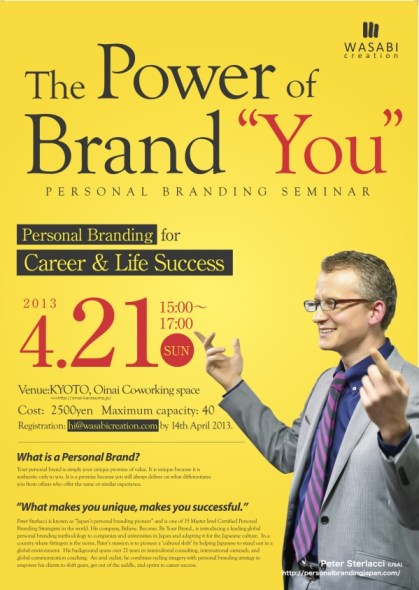
The second message came from a workshop on “The Power of Brand ‘You’: Personal Branding for Career and Life Success.” The workshop is led by Peter Sterlacci, who, according to his own ad, is “known as ‘Japan’s Personal Branding Pioneer’ and is one of 15 Master level Certified Personal Branding Strategists in the world.” (Let’s set aside grammar issues with the excessive use of capital letters, and the questions about who, exactly, knows Mr. Sterlacci in this manner. Maybe it’s just him. Let’s also set aside questions about just what a personal branding strategist is, who certifies such a person, and how many levels there are.)
In the messages on Sterlacci’s website, we can find a few kernels of truth. For example, the Japanese workplace places a high value on workers fitting into the existing hierarchy of the company. In a changing, 21st-century economy, workers need to look for jobs in a more global marketplace—and that marketplace can include settings in which workers need to promote themselves less as workers who can fit in, and more as workers who bring something unique to the company.
So far, so good. But the messages go further, to encourage workers to become their own “personal brand.” You are to be the brand, believe in the brand, and live the brand. But beyond Ophrah-esque messages of believing in yourself, listening to your heart, following your dreams, and opening yourself up to wealth, what does this mean? Am I a brand? (And if I am, are my children my “product line,” like from the iPad comes the iPad mini?)
In my introduction to sociology classes, I discuss Karl Marx’s notion of species being, which we can also think of as human nature. Marx states that humans are unique in our creative ability to produce things. Some animals can build bridges, and a few gorillas have learned sign language, but that doesn’t compare with humans’ ability to create things, from food to clothing, to buildings, to the global computer network on which you’re reading this.
In this sense, this ability is part of what defines us as humans, and we have an intimate connection with the things we create. We become alienated if the products of our labor are taken from us, or if we become little more than appendages to the machines in the factory. Think of the the satisfaction we feel when we make ourselves a nice dinner, compared to the disdain we felt toward the burgers many of us flipped in minimum-wage service jobs. (And if you ate any of the food I prepared at the Solano Drive-In in the 1980s, I apologize.)
In recent decades, our experiences at work have changed dramatically. Once-solid factory jobs in countries like the US and Japan have moved elsewhere, and workers find themselves struggling to find jobs that pay enough to support themselves and their families. Commitments from companies to long-term employment have practically vanished, replaced by temporary or contract work. We’re all free agents now, freed from being trapped in the same job and also free to go hungry while we search for work.
In this environment, it makes sense for workers to retool themselves for the changing dynamics of the workplace. Keep your resume up-to-date, and always be on the lookout for the next opportunity. Believe in yourself, market yourself, take charge of your destiny—think Stuart Smalley meets Gordon Gecko—become the product others want to buy.
And there’s the catch: are you a product? or a brand? or a commodity? or whatever synonym you prefer? What is your value in the marketplace? If you are your brand, and you live that brand all the time, 24 hours a day, are you really living up to your full human potential? Are you reducing yourself to your exchange value? What is your brand worth?
As I kid I remember my brother and I arguing with our dad about what something was worth. We loved some of our stuff so much that we imagined someone would pay us a fortune for it. Then we’d make all sorts of plans to sell our things and reap our rewards. Our father would then tell us that the things were only worth what someone would pay us for them, and that was probably a lot less than we imagined. Not yet schooled in the economics of capitalism, my brother and I confused use value and exchange value. The joy we got from playing with something (it’s utility, or use value) didn’t match the value of that thing in the marketplace (it’s exchange value).
So what happens when the thing we’re trying to sell is ourselves? And what if we buy so deeply into the process that we literally become the product, that we live the brand? Becoming and living your personal brand would involve not only matching the marketing of yourself with your skills and interests, but also shaping your daily life to fit the brand you’ve become. With the brand and the person one and the same, and the brand also a product that is marketed and sold at its exchange value, how in the world can we do this without reducing our humanity down to a tag line, a logo, and a website?
“What makes you unique, makes you successful,” says Sterlacci’s ad in bold print. But what if you’re not successful? Not everyone gets the job of their dreams, since capitalism requires there to be a sufficiently large population of people to be out there, looking for work. And if you don’t succeed, do you blame it on your brand? Do you reincarnate yourself as version 2.0? 3.0? 4.0?
While mired in this process and focusing on your personal brand, how can you engage your sociological imagination, to connect your personal experiences to the bigger picture? How can we find a middle ground, in which people can pursue work that rewards them without selling out and becoming tools. Or brands.
The list reads like something straight from my week 1 Introduction to Sociology lecture. Has he been spying on my classes, or am I just that unoriginal?
Kaufman hopes the list will help people see the importance of identifying as sociologists. I imagine a meeting of Sociologists Anonymous, where scholars come out of the closet and admit their afflictions. “My name is Robert, and I’m a sociologist. It’s been 2 weeks since my last analysis.”
As Kaufman writes, “it wouldn’t hurt if more people proudly proclaimed: ‘I am a sociologist because …” We’re here, we’re analytical, get used to it.
But rather than teach people why “identifying as a sociologist is important,” shouldn’t we teach people to think like sociologists (while writing better)? It’s not the identity that matters, but the perspective and the action that identity can produce.
Kaufman’s reason #33 states “I expect to transform knowledge into action and create a more just and equal world.” It’s not about who gets credit, but about the world we can create.
Here’s Kaufman’s list:
“To this list of lists I add one more: the list of what it means to be a sociologist. Beginning with the prompt: “I am a sociologist because. . . .” here is what I came up with:
I am curious about the world in which I live
I am fascinated by all things social
I am intrigued about why people do the things they do
I am interested in how people interact with each other
I believe that society is a human invention and I want to know how, why, and who invents it
I wonder how meanings are created
I question who has the power to create social norms
I realize that there may be an artificial and even arbitrary distinction between normal and deviant
I am aware that my beliefs, attitudes, values, and actions are based on my social position and not some innate personality traits
I recognize that the time period in which I live has also influenced my beliefs, attitudes, values, and actions
I struggle to be mindful of the biases that may cloud my views
I am suspicious of neat and tidy explanations
I attempt to understand reality from the perspective of others
I listen to the stories that people tell about their lives
I observe social practices and social processes
I collect and rely on data to support my assertions
I focus on patterns and trends instead of on unique individual experiences
I ask questions, and then ask some more, instead of accepting commonly offered answers
I engage myself and those around me with inquiries about the bigger picture
I try to be attentive to the interdependent web of connections that characterize our world
I prefer to explain things based on structural factors rather than just pointing to individual actions
I strive to understand how our lives are impacted by forces such race, gender, sexuality, social class, ability and other such variables
I am angry that inequality is increasing in a world of plenty
I see examples of racism, sexism, homophobia, and other forms of inequality in the fabric of our social institutions such as the media, education, sports, health care, religion, and politics
I am concerned that our inability to recognize institutional forms of oppression often results in our collective denial of such oppressions
I do not stand by silently when I hear others make comments or jokes that are sexist, racist, homophobic or reflect other forms of inequality
I challenge taken-for-granted assumptions that perpetuate inequality, oppression, and injustice
I refuse to accept the social order as natural, inherent, and “just the way it is”
I reject the notion that the status quo is permanent, stable, and everlasting
I maintain that the only thing that is permanent is the impermanence of the world in which we live
I endeavor to be socially aware so that I may see things that others may not recognize
I use my sociological knowledge to deflect harm not cause it
I expect to transform knowledge into action and create a more just and equal world
I am committed to fostering positive social change
I think about sociological ideas
I read sociological books
I study sociological theories and concepts
I write sociological essays and papers
I discuss sociological themes
I encourage others to embrace the sociological perspective
I act like a sociologist by engaging in the behaviors on this list.”
I recently came across the writing of Akemi Johnson, a fellow Fulbright scholar who writes on issues of race, gender, and power in Okinawa. Johnson adeptly connects her experiences as the child of a Japanese American mother and a WASP father with the challenges the women and men of Okinawa face in dealing with the presence of US military bases in the prefecture.
Her website, akemijohnson.com, provides links to several articles that she has published, including a brilliant piece in the Kyoto Journal. She is currently working on a literary nonfiction book based on her experiences in Okinawa. Check out her work!


 I came out of the closet on twitter today with an idea I’ve had for some time. Part of being a junior scholar is learning what ideological wars you don’t have the gravitas to wade into. The hyper-focus on degree completion and persistence is one of those. But since the cat is out of the proverbial bag, I will own this one.


 JAPANsociology