Japan’s national archive recently released documents that detail Japanese troops’ role in the sexual slavery of foreign women during World War II. No word from Osaka Mayor Hashimoto or others who have denied that such events occurred.
Author Archives: japansociology
‘You Mean Women Deserve Careers?’ Patriarchal Japan Has Breakthrough Moment
Time’s second of two articles on gender inequality in Japan …
What’s Holding Japanese Women Back
Time magazine gives Japan a one-two punch of critiques of the country’s treatment of women. First up, Sylvia Ann Hewlett …
Saving 10,000: Winning a War on Suicide in Japan
by Robert Moorehead
Film description from “Saving10000.com“:
In a war on suicide, who is the enemy? ‘Saving 10,000′ is the story of an Irishman’s personal passion to uncover the true causes of the high suicide rate in Japan. The disturbing findings include the Japanese media`s perverse love affair with suicide, a variety of cruel and predatory economic pressures and an outdated and failing mental health care system. With the help of front-line experts and ordinary Japanese, many touched by the horror of suicide, the movie delivers practical proposals on how Japan can win a war on suicide. However with suicide such a taboo, the odds are nobody will listen. Or will they?
“Saving 10,000 – Winning a War on Suicide in Japan” is a 52-minute documentary directed by Rene Duignan and filmed by Marc-Antoine Astier. Unusually for a small low budget documentary, “Saving 10,000″ has attracted a lot of media interest with Rene giving over 30 interviews to date. The movie also sparked interest from politicians with DVD requests from a Minister and Vice-Minister and a screening was held at the Japanese Parliament. Rene has had the privilege of sharing his ideas in a meeting with the Suicide Prevention Unit of the Cabinet Office. After the high profile Japanese media coverage, a large amount of screening requests have been coming from all over Japan. Due to huge public interest and the extreme urgency of raising suicide awareness in Japan, Rene has made the decision to release the full movie online for free. Please note DVDs will be provided free of charge to any organisation/university/NGO that would like to hold a public screening.
Rene will endeavor to fulfill as many speaking requests as is feasible for a “film director” with a day job.
Requests and enquiries to rene.duignan@gmail.com
Immaculate Conceptions and Japanese Citizenship
by Robert Moorehead
According to the Mainichi, on September 13, the Osaka Family Court ruled that a child conceived through sperm donation must be registered as fatherless. The Court rejected the petition of a 31-year-old transgender man and his wife, who had sought to add their son to their family registry. The Tokyo Shinjuku Ward Office had refused to record the man as the child’s father, noting that he was biologically incapable of fathering the child. Instead, the Ward Office left the father section of the family register blank. An immaculate conception!
The man had legally changed his gender in 2008, and married his partner shortly thereafter. The Court ruled that Japanese law bases parenthood on a biological connection between parents and child. Since government officials are unable to watch people conceive their children and they do not require DNA tests to add children to family registers, the standard practice has been to record both parties in a married couple as the child’s parents—even if the child was conceived through sperm or egg donation.
This case comes down to whether the government knows whether you’re capable of conceiving a child. If the government does not know that reproductive technologies have been used, then the parents are in the clear to record the child as theirs. However, if you’re a transgender parent and had legally re-registered your gender, or a woman whose fertility is in question, then your claim to parenthood may be denied.
This privileging of biological ties is inconsistently applied, as in 2003 authorities refused to register actress Aki Mukai as the mother of twins who were born through an American surrogate, and instead registered the surrogate as the children’s legal mother. Mukai’s ova and the sperm of her husband, wrestler Nobuhiko Takada, were used in the surrogacy. However, the Japanese Supreme Court ruled that Japanese law only recognizes the woman who gives birth to the child as the legal mother. Mukai and Takada were required to adopt their children, who were registered as American citizens and foreign residents of Japan.
In another example, a woman’s spouse will be automatically recorded as the father if the child is conceived during the marriage, regardless of who the biological father is. If the woman conceives the child with someone other than her spouse while she and her spouse are separated, and she subsequently divorces and re-marries, the ex-husband will be listed as the child’s biological father.
Why engage in such legal and mental gymnastics? Defenders of the current law say that it is necessary to support the sanctity of marriage. Such marriage laws also legally discriminated against children born to unmarried parents by limiting them to half the inheritance their “legitimate” siblings would receive. On September 4, the Japanese Supreme Court unanimously overturned a 1995 decision that upheld the law.
Following the logic of the Osaka Family Court’s decision, if a child is born through anonymous sperm and egg donations to infertile parents, and the government knows the parents are infertile, that child could legally be recorded as having no parents. An even more immaculate conception!
Such a child would also be stateless. For children to receive Japanese citizenship at birth, they must have at least one parent who is a citizen. Thus, if the mother of the child in the Osaka case is not a Japanese citizen, then her child will also not be a citizen, as the child’s legally non-existent father would not be able pass on citizenship to him.
A further wrinkle is that an overseas birth must be registered with Japanese authorities within 90 days for the child to receive citizenship. Given the dearth of reproductive services in Japan, many women seek services outside the country. If, upon returning to Japan, the couple’s parenthood is in question, the couple must choose whether to register the surrogate as the mother, or challenge the decision and risk missing the window in which to register the child for Japanese citizenship.
Beyond the common situation of the law not keeping up with rapid changes in reproductive technology, these cases show how the law gets twisted and turned as judges and other officials see fit, to support a status quo that does not serve the interests of children or parents.
Travel Shows Mirror Japan’s Imagined Globalization

JAPANsociology got its first mainstream media citation, in a column by Philip Brasor in the Japan Times, “Travel Shows Warp True Globalization.”
Brasor notes the parochial nature of Japanese travel shows, which often depict the world outside Japan as worthy of fear and caution. To paraphrase Jennifer Robertson, such events are about presenting the world in a way that reduces the ontological anxiety Japanese may experience when worrying about Japan’s place in the world.
The 2020 Olympics in Tokyo follow the 2005 World Expo in Aichi, and the 2002 World Cup in Japan and South Korea. Each event was to usher in a new era of internationalization, strengthening Japan’s connection to the rest of the world. Instead, we see the more things change, the more they stay the same. The question isn’t whether Japan is connected to the rest of the world, but how the Japanese people interpret that connection.
As WI Thomas and DS Thomas wrote in 1928, “If men define situations as real, they are real in their consequences.”
Twilight of the Yakuza
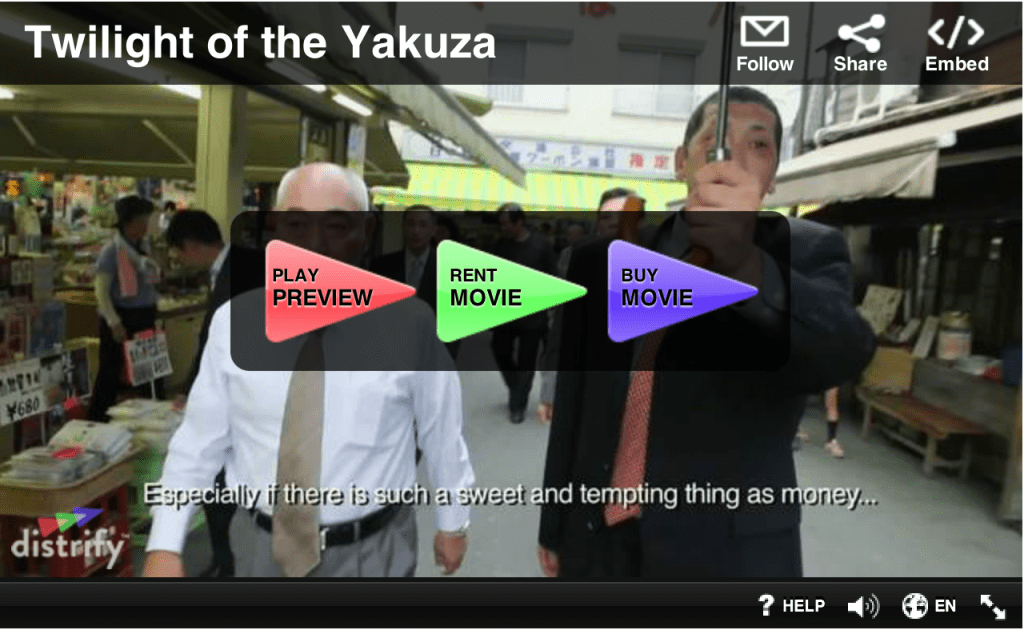
Click on the image to view Twilight of the Yakuza on distrify.com
by Robert Moorehead
Sebastien Stein’s film, Twilight of the Yakuza, explores the decline of Japan’s organized crime syndicates. Stein says the yakuza are a dying breed. Their members are aging and the government of Japan has launched a large-scale crackdown on them to eradicate them once and for all. But who are the yakuza? A threat to public safety or a necessary evil?
(For a detailed review of Stein’s film, check out foreignpolicyblogs.com, and for a great read on the yakuza post-March 11, check out Jake Adelstein’s article on japansubculture.com. The rest of this post borrows heavily from Stein’s description of his film.)
The film follows three members of the yakuza: Yoichi Nakamura, the “Tiger of Ginza” who was recently excommunicated from the Sumiyoshi-kai; Toyohiko Tanaka, head of the Matsuba-kai; and Daikaku Chōdōin, a yakuza consultant. Nakamura’s story is the most compelling, as he struggles at age 60 to leave his yakuza past behind him and succeed as a “legitimate” businessman.
Tanaka laments the low standards and lack of honor of young yakuza. As Jake Adelstein has described them, “the yakuza are Goldman Sachs with guns —increasingly white collar criminals who follow no code and who serve no function in society.” Deeply rooted in Japanese society, the yakuza are seen as a necessary evil and ‘problem solvers.’ They have been around since the 1700s and were said to protect the weak from the strong, following a rigorous code of honor. Several clans even contributed aid for the victims of the recent earthquake and tsunami. As Adelstein notes:
in the midst of the dark days that followed the great earthquake, there was a time when the yakuza lived up to their claims to be humanitarian groups, and it was oddly inspiring. For a brief time, the yakuza, the people and the police all had a common enemy: natural disaster. And as the saying goes, ‘the enemy of my enemy is my friend’ and for that short time — it seemed like we were all friends.
Unlike the mafia, the yakuza is a legal, public group making them relatively easy to check on. You can find their offices by looking on the National Police Agency website, and you can read all about them in their many fanzines. I’ve even sat near them at Japanese pro baseball games in Nagoya, while they tried to explain the sport to the Filipino women sitting with them. Strict government crackdowns have moved many yakuza underground. As the police concentrate their resources on the yakuza, many criminals simply don’t register with clans anymore and start operating underground, evading the grasp of police. A clear trend is emerging towards a new structure of organized crime in Japan, resulting in a steep decrease in the numbers of the traditional yakuza while the underground is soaring – including foreign Russian and Chinese mafias.
This documentary deals with the struggle of the yakuza for its survival and the restructuring of the organized crime scene in Japan. Furthermore, unprecedented access to the secret world of the yakuza gives you an insight on who the yakuza are: criminals, outcasts, but also family men and a part of Japanese society.
Japan Grapples with the Rise of Hate Groups
This YouTube video from “The Real News.com” provides an interesting and informative look at the recent protests against resident Koreans and other minority groups in Japan.
Japan to Foreigners: Tell Us How Impressive We Are
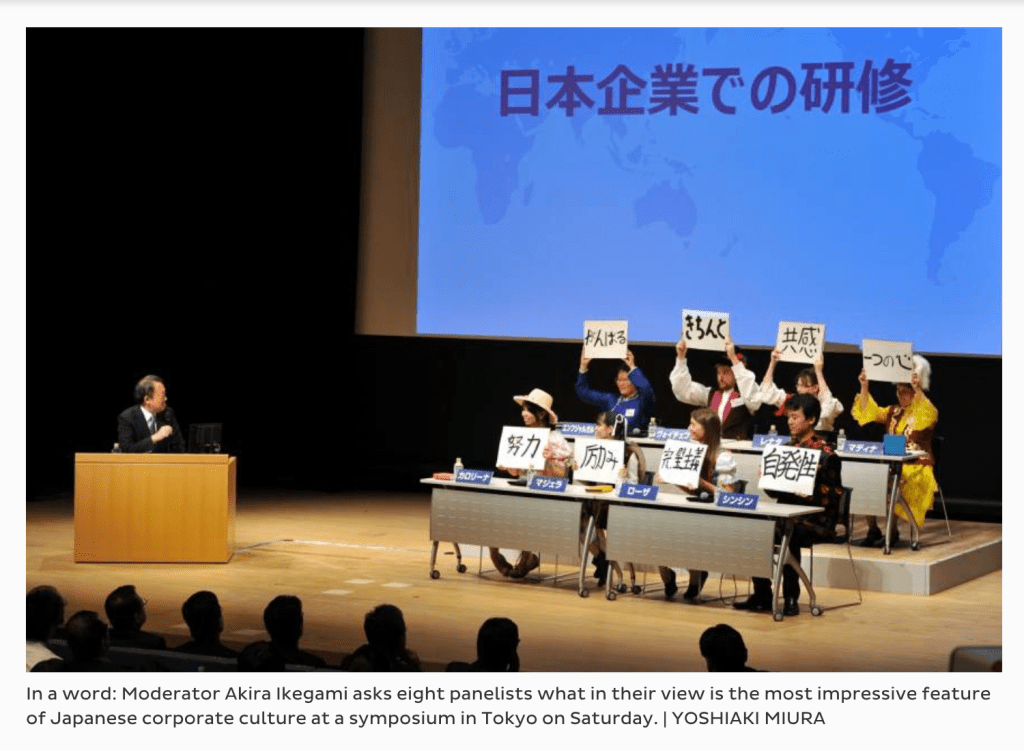
From the Japan Times
by Robert Moorehead
The above photo and caption from the Japan Times really says a lot about Japanese attitudes toward the country and the rest of the world.
The article is about a symposium in which youth from various countries, and dressed in their ethnic attire, gave short speeches in Japanese about peace and communication. Hailing from the United States, Poland, Mexico, Brazil, Germany, Romania, Kazakhstan and China, the speakers spent a month in Japan, visiting various sites, including Toyota Motor Corporation and tsunami-hit areas of Tohoku.
One speaker discussed the need to challenge Japanese stereotypes of Romania as a dangerous place. Another discussed the need for people in Poland to become more rule-abiding, like the Japanese.
We can analyze the symposium, and others like it, as performances that are staged to define meanings and relationships. In particular, the symposium is about “internationalization” and “native place-making.”
As Jennifer Robertson notes in her article “Empire of Nostalgia,” “internationalization and native place-making exist coterminously as refractive processes and products, and … together they index the ambiguity of Japanese national identity and its tense relationship with cultural identity (or identities)” (p. 98).
While the symposium includes the views of non-Japanese, the event is less about “securing a place for ‘real’ foreign bodies in Japan and more about reducing the level of ontological anxiety supposedly experienced by Japanese” (p. 101) who worry about Japan’s place in the world, or who are exposed to non-Japanese inside Japan.
The photo at the top of the article captures a telling moment, in which the speakers are asked to hold up signs displaying their thoughts on “the most impressive feature” of Japanese corporate culture. In other words, they were asked to tell their hosts how great they are.
The cynic in me imagines the conversation going a little like this: “First question, tell us how great our corporations are. Second question, tell us how great our culture is. Third question …” you get the idea. “Now go back to your countries and teach everyone how great we are.” By implication, the message is also how inferior the youths’ home countries are.
After spending a month in Japan, these youth are not going to be offering analytical insights on life in Japan, or on the merits or demerits of the organizational culture of Japanese corporations. But that’s not the point. The point is to reify differences between Japan and the rest of the world by dressing up foreigners in ethnic attire and having them talk about Japan from “foreign” perspectives.
Robertson notes something similar in the inclusion of foreign residents in a parade during the city festival in the Tokyo suburb of Kodaira. In 1992, City Hall allowed the first foreigner contingent to march in the parade, and required the foreigners to dress in kimono.
Instead of using the parade as an opportunity to display visually the differences represented by a multi-ethnic assortment of resident foreigners, City Hall has insisted on their marching dressed in kimono. Accompanying the sartorially Japanized foreigners are Japanese residents wearing the stereotypical folk costumes of the representative foreign countries. Both parties are reduced to caricatures of cultural and ethnic difference in a spectacle informed by an underlying ontological anxiety (fuan). (p. 100)
… what is represented as ‘international’ is but dominant stereotypes of the national characters, as it were, on parade (e.g. lederhosen for Germany and Stetson hats for the USA). Not only do the kimono-wearing foreigners reify Japanese tradition, but the diverse cultures they represent are reduced to the quaint and unthreatening images embodied by the costumed Japanese. (p. 117)
In 2006, my family and I participated in the city festival in Kasugai, in Aichi Prefecture. Our role was to sit at a table in City Hall so that Japanese could come up to us and practice speaking English. We smiled as people approached us and said hello, or pushed their children use the English they had been learning in school and private lessons. After two hours, we had sufficiently performed our role of reducing English-speaking foreigners to “quaint and unthreatening images,” while making Kasugai seem like a cosmopolitan hub of cross-cultural communication. There were no tables where Japanese could try their hand at speaking other languages, and my neighborhood still had crime-watch signs in Chinese posted in front of nearly every home, so Kasugai still had a long ways to go before it became truly “international.”
These events define Japanese and foreigners as distinct entities, and internationalization as a controlled space where the twain shall meet only briefly, and under safe conditions—like going to the zoo, except in this case, the animals are not asked to tell the humans how impressive they are.
References
Robertston, Jennifer. 1997. “Empire of Nostalgia: Rethinking ‘Internationalization’ in Japan Today.” Theory, Culture & Society 14(4):97-122.
TEPCO, Nuclear Disaster & Spaghetti-Os: Bad Deeds Get Rewarded
by Robert Moorehead
I’m re-blogging Jake Adelstein‘s brilliant post from the Japan Subculture Research Center. Adelstein figures out TEPCO’s plan: to do a sufficiently poor job of cleaning up the Fukushima nuclear disaster that the Japanese government has to take over. The more TEPCO spends cleaning up the mess, the less profit it makes. So it spends as little as possible, until the situation becomes so untenable that it gets relieved of the responsibility.
As Homer Simpson said, “If adults don’t like their jobs, they don’t go on strike. They just go in every day and do it really half-assed.”
The mis-measurement of radiation at the plant is especially mind-blowing: TEPCO used devices that maxed out at 100 millisieverts, thereby avoiding having any record of the true radiation levels, which were later measured at 1800 millisieverts, which enough to kill a person after 4 hours of exposure.
This clever use of technology reminds me of the speedometers on American cars in the 1970s and 1980s, which topped out at 85 mph. So, if you floored the gas pedal and kept it floored as you flew down the highway, you would have no visual cue that you were going any faster than 85. Unless you looked out the window, of course.
Or maybe if you don’t want to know how much weight you’re putting on, but you’re expected to weigh yourself every day, get a scale that tops out at your ideal weight.
TEPCO, Nuclear Disaster & Spaghetti-Os: Bad Deeds Get Rewarded.
Tokyo Electric Power Company, TEPCO, is getting a lot of criticism for its inept clean-up attempts of the Fukushima nuclear power plant site, which had triple-meltdowns in March of 2011—after the company had failed to take precautions which might have prevented the meltdown in the first place. There is also a 4th reactor where spent fuel rods are waiting to be extracted, and if mishandled they have the potential to release huge amounts of radiation into the air. TEPCO, like the Central Intelligence Agency, has a wonderful legacy of failure, and now it literally has “a legacy of ashes”.
To read more, check out Jake Adelstein’s full post.
 JAPANsociology